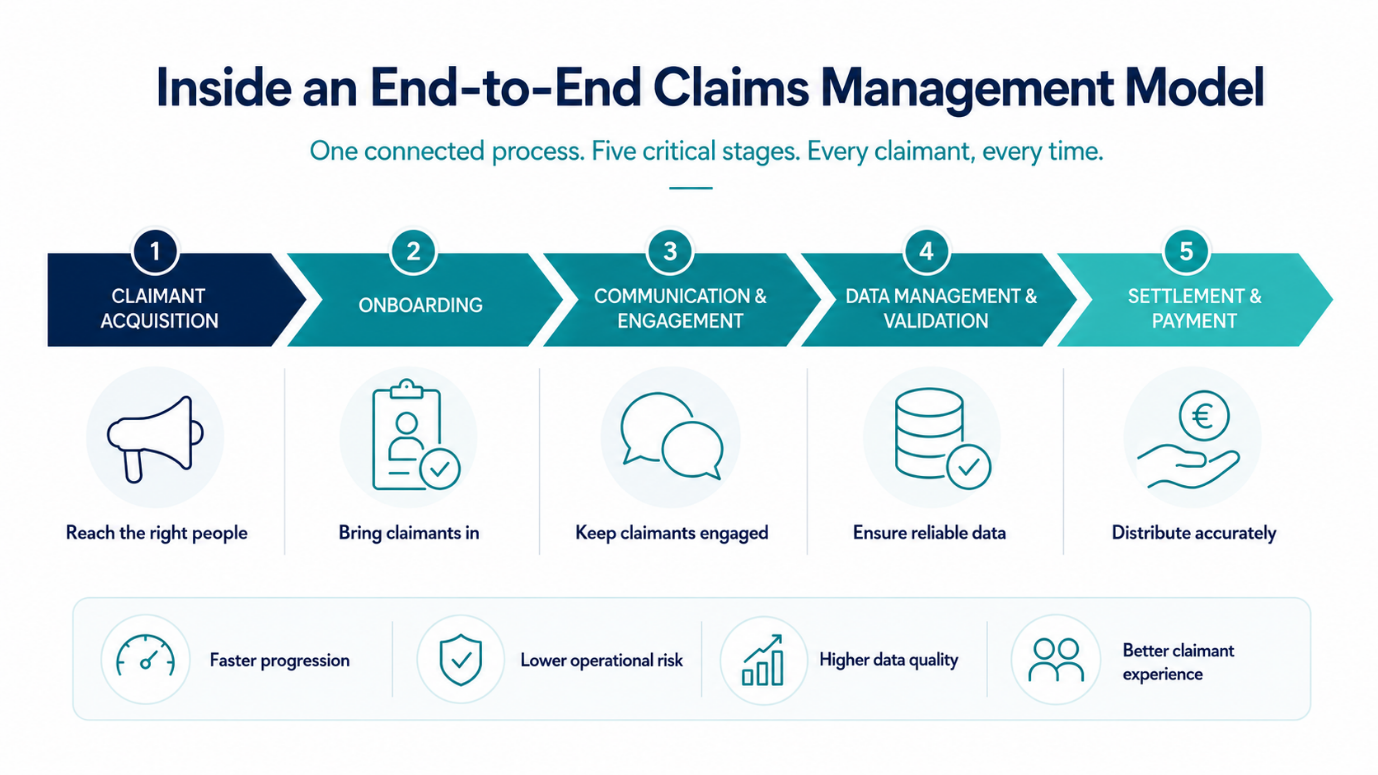
In collective and mass claims, the difference between a well-run case and a chaotic one often comes down to how the process is structured. End-to-end claims management means taking ownership of every operational stage, not just one part of it. It is, in short, an integrated framework in which every phase of a claim connects to the next.
For law firms, litigation funders, consumer associations, and claim organisations, this matters because gaps between stages create risk. Information gets lost, claimants disengage, timelines slip. A true end-to-end model eliminates those gaps by ensuring that the full claimant lifecycle is managed with the same discipline from start to finish.
Claimant acquisition
Every collective action starts with identifying and reaching the people who are eligible to participate. This is not a passive process. Effective claimant acquisition (sometimes referred to as book-building) requires targeted outreach, compliant digital marketing, and a clear strategy for reaching the right audiences quickly. The size and quality of the claimant group at this stage directly shapes the strength of the case that follows.
Onboarding
Once claimants are identified, they need to be brought into the process efficiently and accurately. Onboarding covers registration, document collection and review, and the initial intake of all relevant claimant information. A smooth onboarding experience reduces drop-off, improves data quality, and sets the right tone for the claimant relationship. Whether claims are institutional, B2B, or consumer-facing, the onboarding process should be adapted to reflect the profile and expectations of each claimant group.
"The Arco case is a good example of what the model looks like under pressure. We were facing a filing deadline that could not be moved less than 3 months after launching our marketing campaign. We were able to simultaneously onboard more than 13,000 claimants and ensure that each claim was ready for submission. That kind of result comes from having a structured acquisition strategy, a well-designed onboarding flow, and an operational team managing every step in between, in real time, with no margin for error."
Vincent Van Cauwenbergh, Claims Management Consultant
Communication and engagement
A collective action can run for years. Throughout that time, claimants need to feel informed, supported, and confident that the process is progressing. Clear, timely communication, at each milestone and whenever the situation changes, keeps claimants engaged and reduces the operational burden of managing inbound queries. Disengaged claimants create delays. Well-informed claimants move the case forward.
Data management and validation
Accurate data is the foundation of a defensible claim. Every claimant record needs to be complete, consistent, and validated against the relevant eligibility criteria. Structured data management processes ensure that what has been collected can be relied upon, by legal teams, by funders, and ultimately by the courts or settlement administrators. This is not a back-office concern. It is central to the credibility of the entire claim.
Settlement and payment
The final stages of a collective action are where everything either comes together or falls apart. Settlement processes need to be managed with precision: claimant records reconciled, entitlements calculated, and payments distributed accurately and on time. For claimants who have waited years for a resolution, this stage defines their experience of the entire process. It must be handled with the same rigour applied at every earlier stage.
Liliane Kabera, Claims Management Analyst
Conclusion
An end-to-end claims management model works because it treats the claimant lifecycle as a single, connected process rather than a series of separate tasks. Each stage feeds into the next. Weakness at any point creates problems downstream. When claimant acquisition, onboarding, communication, data validation, and settlement are managed as one integrated framework, with the right platform, the right team, and structured processes throughout, collective and mass claims are better positioned to deliver results efficiently, accurately, and at scale. It is an approach we have applied across more than 50 cases and 60k+ claimants managed to date, and one that continues to define how we work.