Technology has become central to how collective and mass claims are managed. The ability to onboard thousands of claimants, automate document checks, and coordinate across multiple systems has made large-scale claims operations faster and more accessible. For law firms, litigation funders, and claim organisations, a reliable platform is no longer optional, it is foundational.
But technology alone does not deliver results. The collective actions that succeed, and the claimants who ultimately receive compensation, are supported by something broader: experienced people, clear communication, and structured operational support; working alongside the platform, from first contact to final distribution.
The role of technology
A well-built claims platform handles a great deal. It enables claimants to register, submit documentation, and move through the process without unnecessary friction. It validates data at scale, reduces manual workload, and provides visibility across the full claimant lifecycle. For any organisation managing a collective action, these capabilities are essential, and the right platform will make the entire operation more efficient and more defensible.
The role of operational support
Technology executes what it has been designed to do. It does not adapt when a jurisdiction changes its requirements mid-case, resolve ambiguous claimant documentation, or manage the exceptions that complex disputes inevitably produce. Human oversight remains essential; to maintain quality, manage escalations, and ensure that the claims management process stays on track even as circumstances evolve. Experienced teams bring the judgement and accountability that no platform can replicate alone.
"On the Fortis/Ageas case, we were coordinating over 6,500 retail clients and 600 institutional investors, processing around 35,000 transactions. The platform handled the structure. But the decisions on how to communicate with claimants in different jurisdictions, how to align our reporting with the WCAM settlement administrator, how to manage exceptions that no system could have anticipated, required people who understood both the legal context and the operational reality. That is what end-to-end claims management actually means in practice."
The role of communication
Claimants need to understand what is happening and what is expected of them throughout a claim. Without clear, timely, and accessible communication, even well-organised processes can stall, through incomplete submissions, low engagement, or avoidable confusion. Keeping claimants informed is not a secondary concern. It is a core part of what makes a collective action work in practice.
The role of process and structure
Behind every successful collective or mass claim is a set of disciplined workflows: structured onboarding, consistent data validation, clear escalation paths, and organised case management from acquisition through to settlement and payment distribution. These processes allow claims to scale without losing accuracy or control. They also make the overall case more robust, ensuring that everything collected and managed can withstand scrutiny when it matters most.
Why the combination matters
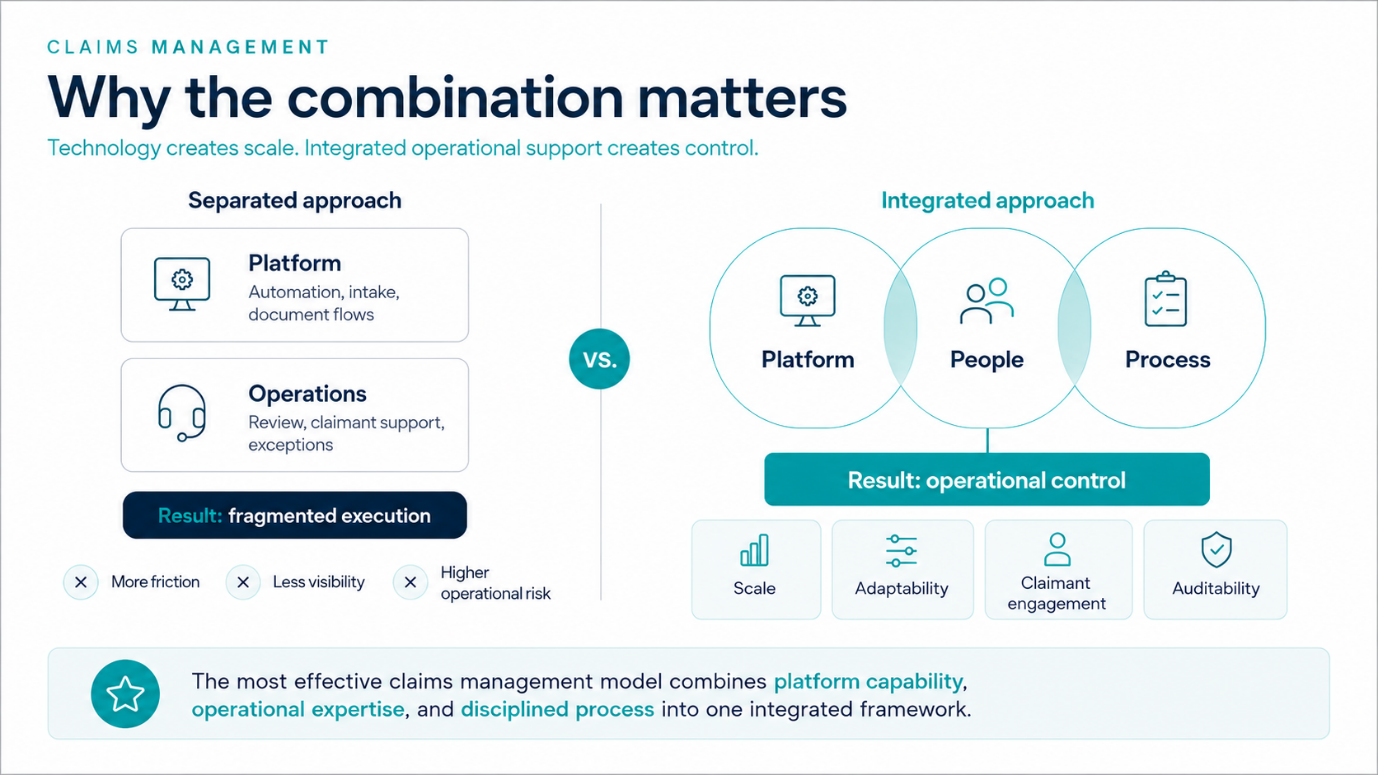
The strongest outcomes come from combining platform capability, operational expertise, and structured process into a single, integrated solution. Each element reinforces the others. A powerful platform performs better when operated by people who know how to manage complex multi-jurisdictional claims. Experienced teams are more effective when supported by tools that reduce administrative burden. And both deliver stronger results when underpinned by repeatable, audit-ready processes that keep the claim progressing at every stage.
“Delivering outcomes at scale in complex claims environments requires more than technology. It requires a deliberately designed operating model where platform capabilities, operational expertise, and structured processes are tightly integrated. Each layer amplifies the others: technology reduces friction and enables scale, expertise brings context and decision-making, and process ensures consistency, transparency, and control.
With Aggregate360, we have moved beyond a traditional platform approach to build a system designed for complexity. Structured onboarding, Intelligent document handling, digital signature workflows, and real-time dashboards all contribute to creating a controlled and auditable environment for managing claims.
What differentiates our platform is that it has been built around 20+ years of operational experience. The workflows reflect how cases are actually run, ensuring that the systems reduce administrative burden and bring structure, visibility, and control to each stage of the process, creating the foundation for scalable and increasingly intelligent operations.”
Conclusion
Collective and mass claims are operationally demanding. Technology is a critical enabler, but it is not a complete solution. The most effective claims management model brings together a reliable platform, hands-on operational support, transparent claimant communication, and disciplined process structure. Not as separate components, but as one integrated framework built to deliver results across every stage of the claimant lifecycle.